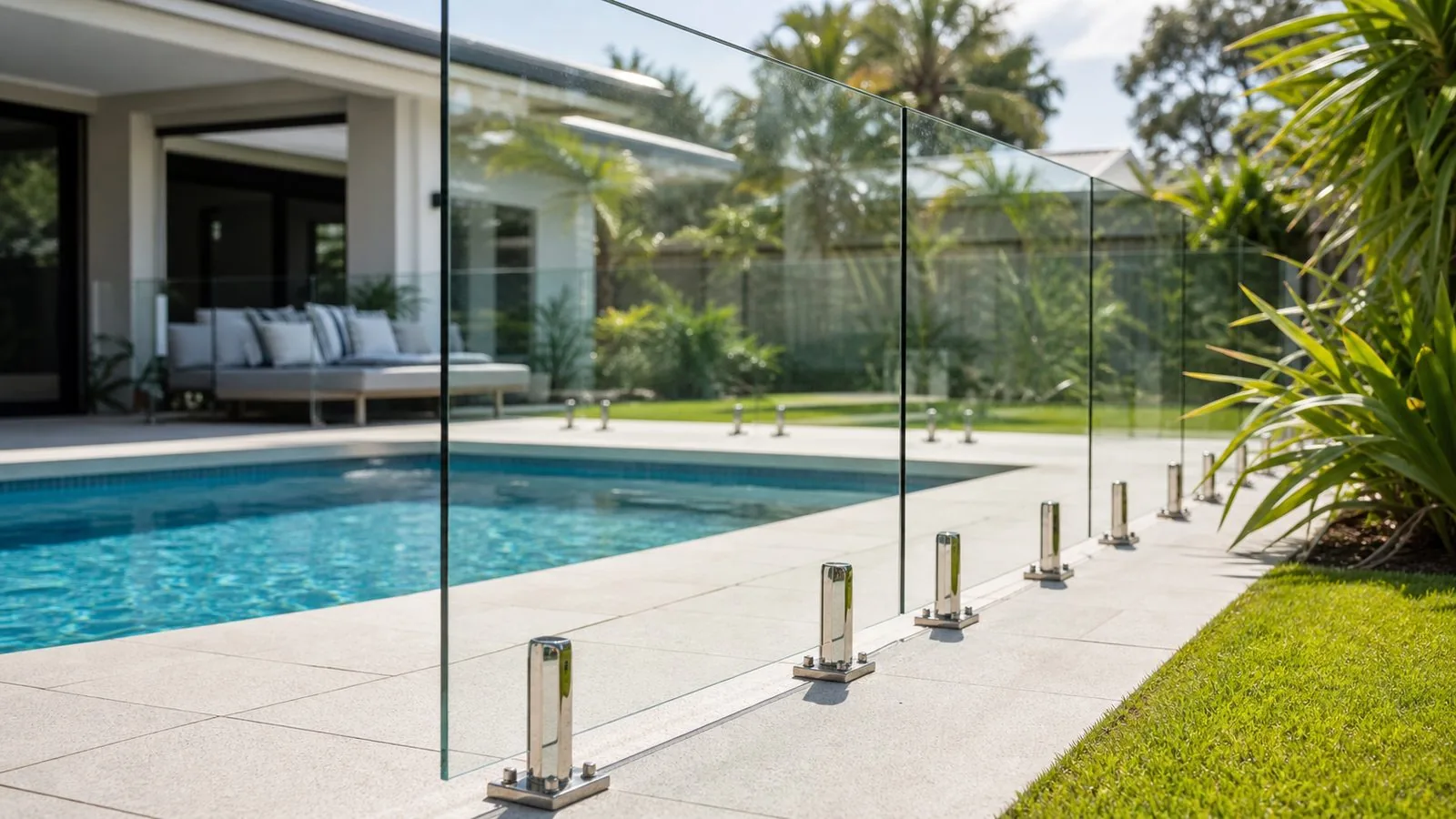
Identify the fencing system before ordering a panel
Replacing one glass pool fence panel starts with identifying the system around it. Two panels can look alike while differing in their dimensions, edge treatment, holes, notches or the hardware they are intended to work with. A replacement should therefore be specified by a qualified supplier or installer using the actual site and product information. The owner's most useful contribution is an organised identification brief. This guide explains what to record and which decisions to ask about, without turning panel replacement into a do-it-yourself glazing job.
If glass is broken, cracked or loose, keep people away from the affected area and arrange professional help with the barrier and damaged material. Do not handle fragments, lean on adjacent panels or remove fittings to obtain measurements. A missing panel also raises the question of barrier continuity, which must be addressed separately from ordering replacement glass. The temporary barrier planning guide describes the coordination questions. A supplier's estimated manufacturing date is not a plan for controlling pool access while the opening remains.
Give the affected bay an unambiguous identity
Start with an overview photograph from a safe position that shows the affected section and the neighbouring panels. Mark the location on a simple sketch, using recognisable references such as the house corner or gate. Numbering bays on a copy of the photograph can help when several sections look similar. Keep the original photograph as well. A supplier should not have to guess whether a close-up shows the left or right side of the gate. Ambiguous locations can lead to discussions about the wrong component.
Describe whether the affected piece is a fixed panel, a gate, a panel supporting gate hardware or a section at a corner. Note whether the fence uses posts, spigots, channels or another visible support arrangement. Use ordinary descriptions if you do not know the product name. Photographs and existing paperwork are more reliable than guessing a model from a web image. The installer can then decide what needs to be measured on site. The owner should not attempt to remove a panel or loosen clamps to identify its mounting details.
Look for paperwork before relying on appearance
Search for the original invoice, fencing quotation, supplier information and any product labels retained at installation. The documents may identify the manufacturer, system, glass specification and hardware family. Record the installation date if it is known, but distinguish it from the date of a later repair. A fence can contain components from more than one period. If an earlier panel was replaced, tell the installer which one. Otherwise, they may assume every panel belongs to the same original specification when the site history is more complicated.
Visible glass markings can be useful identification clues. Photograph them only where they can be seen safely without touching damaged glass or entering a hazardous area. Do not scrape, polish or apply chemicals to expose a faint marking. Record what is legible and leave uncertainty explicit. A marking does not by itself prove the condition or suitability of a whole installed system. It is one piece of evidence for the professional specifying the replacement. Keep it with the overview photograph so the mark can be associated with the correct panel.
Separate glass dimensions from the size of the opening
The opening between neighbouring components is not necessarily the same as the required glass dimension. The supplier needs to account for the actual system and its interfaces. This is why ordering from a rough tape measurement can be misleading. Ask the installer who takes responsibility for the final measure and the manufacturing specification. If the supplier requests preliminary dimensions for an estimate, label them as preliminary. Do not reach across an opening, climb furniture or handle broken glass to obtain a more precise number.
Ask about the information needed beyond width and height. The discussion may include shape, edge finish, holes, notches and the relationship to adjacent hardware. A rectangular panel in a photograph may conceal details at the fittings. The professional should establish those details before the order is released. Keep any drawing revision with the quotation and confirm which revision has been approved for manufacture. This is especially useful if a panel has been remeasured after a support repair or a change to the surrounding finished surface.
Treat a gate panel as a hardware interface
Gate replacement needs an assessment of the gate and its hardware together. Ask the installer to identify the hinges, latch, supporting panel or post and the intended glass interface. A panel that appears to fit between two points is not enough to establish a compatible assembly. Describe any previous closing or latching problems, including when they began relative to the glass damage. Do not adjust hinge tension or remove fittings to demonstrate the problem. A video already recorded safely may help, but the professional should determine the necessary checks.
If the existing hardware is being retained, request confirmation that it is suitable for the replacement specification and its present condition. If hardware is changing, ask whether that changes the glass order or the surrounding support arrangement. Keep those decisions in the same scope rather than purchasing the gate first and selecting fittings later. The site's pool gates and hardware page describes the service category. For an existing fault, distinguish the task of restoring operation from the separate task of matching the visual appearance of the new glass.
Check neighbouring components without assuming a cause
Tell the assessor about visible movement, corrosion, recent impacts, ground work or changes to the fence. These observations may affect the investigation, but they do not prove why a panel failed. Avoid labelling the cause from the break pattern or an online photograph. Ask the professional what can be established from the available evidence and what remains uncertain. If several components need attention, request a clear explanation of which work is necessary for the replacement and which work is an optional wider improvement.
Do not assume a new panel resolves a damaged support. Equally, do not assume every neighbouring panel must be replaced simply because one has failed. The scope should follow the assessed condition and compatibility of the actual system. Ask for the reasons behind the proposed extent of work. This helps compare a single-panel proposal with a wider renewal proposal on their merits. A useful answer identifies the component or uncertainty driving the recommendation rather than relying on a general statement that older fencing should all be replaced.
Compare visual matching with documented compatibility
Owners often notice differences in tint, edge appearance or reflection after a replacement. Discuss how close a visual match is realistically expected before ordering, particularly where the existing glass has weathered or the original product is no longer available. Ask whether a sample or specification comparison can clarify the appearance. Do not let a promise of an exact visual match stand in for confirmation of compatibility. The replacement must be specified for the system and application; matching the colour of a neighbouring edge is only part of the conversation.
Product documentation helps make that distinction. The Glass Outlet certification library, for example, separates its pool fence systems into different document sets. Use the selected supplier's current information for the actual proposed components, rather than treating a generic certificate as covering every assembly. Ask who will confirm the replacement arrangement and what documents will be provided. This page does not endorse a particular supplier or prescribe a glass thickness. The appropriate specification depends on the identified system and the professional assessment of the property.
When the original system is discontinued
A discontinued product requires a compatibility discussion before an order is placed. Ask whether an equivalent component is documented for the existing assembly, whether associated hardware must change or whether renewing a defined section is the more practical option. The answer should identify what is known about the original system. A salesperson's statement that a new panel is usually suitable is less useful than a specification that names the retained components and the proposed replacement. If the system cannot be identified, record that uncertainty rather than hiding it in the quote.
Compare the consequences of each option. Replacing one panel may preserve the appearance and minimise disturbance, but it can depend on a special order. Renewing a complete run may change the visual rhythm, support locations and scope of reinstatement. Neither option should be chosen solely because it sounds smaller or newer. Ask what future repair information will be available after the work. A documented replacement system can make the next maintenance decision easier, whereas an undocumented mixture of components can leave the same identification problem for the next owner.
Example: one missing fixed panel beside a gate
Consider a hypothetical fence where a fixed glass panel beside the gate needs replacement. The owner initially assumes the gate itself is unaffected because its glass is intact. The identification brief shows that the fixed panel carries part of the gate hardware, so the installer assesses the interface before specifying the replacement. The owner supplies the old invoice and a photograph from before the damage. Final measurements and component selection remain with the professional, and a separate barrier arrangement is maintained while the work is planned.
In this example, the written scope identifies retained hardware, replacement components, any support work and the required completion checks. The owner can now compare proposals that address the same problem. This is a fictional planning example, not a report of a completed Gold Coast job. Its point is that the role of a panel matters as much as its appearance. A panel beside a gate can be part of a larger assembly, so describing it only as one rectangle of glass leaves out the information needed for a responsible replacement decision.
Keep the replacement record for the next repair
At handover, retain the final panel specification, relevant product documents and the installer's record of what was changed. Note which components were retained and which were replaced. Ask how any required barrier assessment has been addressed and keep those documents with the fencing records. The QBCC homeowner guide is an official reference for the broader pool safety context. Do not treat a delivery docket for new glass as evidence that the completed barrier has been assessed.
Finally, photograph the completed section from the same safe viewpoint used in the original brief. Label the date and bay location. The record should make sense to someone who did not attend the job. This takes little effort compared with rediscovering the system years later, and it helps a future installer distinguish the replacement from original components. Your record is not a substitute for professional documentation. It is a practical index that connects the documents to the actual section of fence and preserves the reasons for the decisions made.
Your project briefing checklist
Assemble the panel identification evidence for the installer without touching damaged glass. All items checked means the identification brief is ready, not that a replacement has been specified or approved. This tool sends no information.
Optional progress counter requires JavaScript. Use the checklist as written notes.